Main Page: Difference between revisions
Jump to navigation
Jump to search
No edit summary |
|||
| Line 5: | Line 5: | ||
| align="left" width="480px" | [[File:pymate-powered-by-micropython.png|450px]] | | align="left" width="480px" | [[File:pymate-powered-by-micropython.png|450px]] | ||
| align="Left" width="450px" valign="top" style="padding:10px" | | | align="Left" width="450px" valign="top" style="padding:10px" | | ||
<p style="text-align: center; margin-top: 45px; padding: 35px 10px 35px 10px; border-radius: 10px 10px 10px 10px; border: 1px solid #cccccc; background-color: #f89750;">''' | <p style="text-align: center; margin-top: 45px; padding: 35px 10px 35px 10px; border-radius: 10px 10px 10px 10px; border: 1px solid #cccccc; background-color: #f89750;">'''PymateIO''' is an affordable Industrial Controler (PLC) Powered with MicroPython.<br />'''PymateIO''' is ready for Industry, Reliable, Developer-Friendly and Easy to Install.<br /><br /> | ||
'''Micro Python''' is an optimized version of Python 3 dedicated to embedded systems like microcontollers.<br />Python scripts are stored on the device and running on z bare metal Python Virtual Machine (like computer does).</p> | '''Micro Python''' is an optimized version of Python 3 dedicated to embedded systems like microcontollers.<br />Python scripts are stored on the device and running on z bare metal Python Virtual Machine (like computer does).</p> | ||
|} | |} | ||
== | == PymateIO boards == | ||
=== Products Key Facts === | === Products Key Facts === | ||
| Line 42: | Line 42: | ||
{{ttuto | {{ttuto | ||
|label= | |label=Core board | ||
|descr=Tour of the <strong> | |descr=Tour of the <strong>PymateIO Core</strong> board. | ||
|img=tlogo-core.jpg | |img=tlogo-core.jpg | ||
|link=Pymate-Core-Tour | |link=Pymate-Core-Tour | ||
| Line 50: | Line 50: | ||
{{ttuto | {{ttuto | ||
|label=16ADI16DO board | |label=16ADI16DO board | ||
|descr=Tour of the 16 Analog-DataIn and 16 DataOut board. | |descr=Tour of the PymateIO 16 Analog-DataIn and 16 DataOut board. | ||
|img=tlogo-16adi16do.jpg | |img=tlogo-16adi16do.jpg | ||
|link=Pymate-16ADI16DO-Tour | |link=Pymate-16ADI16DO-Tour | ||
| Line 107: | Line 107: | ||
* Scheduling tasks | * Scheduling tasks | ||
== | == PymateIO Expansion Bus == | ||
{{traduction}} | {{traduction}} | ||
* The connector | * The connector | ||
| Line 116: | Line 116: | ||
== References == | == References == | ||
{{traduction}} | {{traduction}} | ||
* | * PymateIO library | ||
* Helper libraries | * Helper libraries | ||
Revision as of 18:30, 25 April 2026
About PymateIO

|
PymateIO is an affordable Industrial Controler (PLC) Powered with MicroPython. |
PymateIO boards
Products Key Facts

|
Pymate Core Core8ADI8DOSC
|

|
blabla |
Product Nomenclature
Products tour
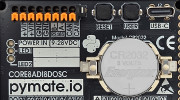
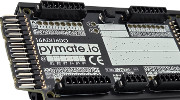
Programming HowTo
 | Page(s) under construction. |
- About MicroPython
- IDE and tools
- Connecting your board
- REPL: the command line
- main.py and boot.py
Programming First-step
| Page(s) under construction. |
- PymateIO methods
- Digitial Input/Output
- Analog Input
- User button
- User LEDs
- Real-Time clock
- Cycle timing
- PymateIO and 16ADI16DO
Common use-cases
| Page(s) under construction. |
- Remote Control (Télérupteur)
- Time relay (relais temporisé)
- Hystersis management
- Value mapping
- PID control
- Fine LED control
- Emergency Stop (using IRQ)
- Watchdog
- Data-Logging
Mini projects
| Page(s) under construction. |
- Tank refill
Expansion programming
| Page(s) under construction. |
- About board_id
- CAN bus scanning
- 16ADI16DO Programming
- Setting board_id
- Digital Input/Output
- Analog Input
Advanced programming
| Page(s) under construction. |
- About asyncio
- Creating tasks
- Scheduling tasks
PymateIO Expansion Bus
| Page(s) under construction. |
- The connector
- Accessing I2C bus
- Accessing SPI bus
- About CAN bus
References
| Page(s) under construction. |
- PymateIO library
- Helper libraries