Main Page: Difference between revisions
Jump to navigation
Jump to search

| Line 229: | Line 229: | ||
== Common use-cases == | == Common use-cases == | ||
{{traduction}} | {{traduction}} | ||
{{ttuto-begin}} | |||
{{ttuto | |||
|label=Remote Control | |||
|descr=Click once to power it on. Click again to power it off. | |||
|img=tlogo-remote-control.png | |||
|link=PymateIO-remote-control | |||
|traduction=1 | |||
}} | |||
{{ttuto | |||
|label=Time Relay | |||
|descr=Click to power/light-up for a while. | |||
|img=tlogo-time-relay.png | |||
|link=PymateIO-time-relay | |||
|traduction=1 | |||
}} | |||
{{ttuto | |||
|label=Hysteresis | |||
|descr=Hysteresis management in running process | |||
|img=tlogo-histeresys.png | |||
|link=PymateIO-hysteresis | |||
|traduction=1 | |||
}} | |||
{{ttuto | |||
|label=Value Mapping | |||
|descr=Great Trick to save time and coding | |||
|img=tlogo-mapping.png | |||
|link=PymateIO-mapping | |||
|traduction=1 | |||
}} | |||
{{ttuto | |||
|label=PID | |||
|descr=Running a PID controller on Pymate | |||
|img=tlogo-pid.png | |||
|link=PymateIO-PID-controler | |||
|traduction=1 | |||
}} | |||
{{ttuto | |||
|label=LED Tuning | |||
|descr=LED can do so much more than being on or off.<br />HeartBeat, Pulsing, ErrorCode and more can be so useful. | |||
|img=tlogo-LED-Tuning.png | |||
|link=PymateIO-LED-Tuning | |||
|traduction=1 | |||
}} | |||
{{ttuto | |||
|label=Interrupt Request | |||
|descr=Being quickly warned of an event! | |||
|img=tlogo-IRQ.png | |||
|link=PymateIO-IRQ | |||
|traduction=1 | |||
}} | |||
{{ttuto | |||
|label=Interrupt Request | |||
|descr=Being quickly warned of an event! | |||
|img=tlogo-IRQ.png | |||
|link=PymateIO-IRQ | |||
|traduction=1 | |||
}} | |||
{{ttuto | |||
|label=Watchdog | |||
|descr=Re-inforce Cycle Time with WatchDog | |||
|img=tlogo-watchdog.png | |||
|link=PymateIO-watchdog | |||
|traduction=1 | |||
}} | |||
{{ttuto | |||
|label=Data Logging | |||
|descr=Permanent storage of history, sensor data, etc | |||
|img=tlogo-data-logging.png | |||
|link=PymateIO-data-logging | |||
|traduction=1 | |||
}} | |||
{{ttuto-end}} | |||
== Mini projects == | == Mini projects == | ||
Revision as of 23:50, 4 May 2026
About PymateIO

|
PymateIO is an affordable Industrial Controler (PLC) Powered with MicroPython. |
PymateIO EcoSystem
PymateIO is expandable by design starting with few board, new arrivals should come with time.
Key products

|
PymateIO Core Core8ADI8DOSC
|

|
PymateIO 16ADI16DO expansion
|

|
CommandHMI [COMING SOON]
|
Product Nomenclature
| Letter | Feature |
|---|---|
| DI | Digital Input. It is prefixed with the number of input (ex : 8DI or 8ADI).
May be in combination with A. |
| A | Analog Input. It is prefixed with the number of analog input (ex : 8A or 8ADI).
May be in combination with DI. |
| DO | Digital Output. It is prefixed with the number of analog output. |
| S | Serial (RS485, MODBUS RTU) |
| C | CAN bus |
| P | SPI bus |
| I | I2C bus |
| U | UART |
| T | Modbus TCP |
Products tour
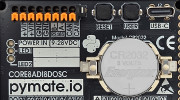
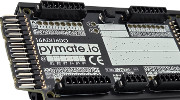
Programming HowTo

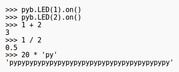
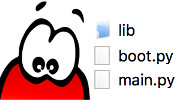
Programming First-step

Common use-cases
 | Page(s) under construction. |
TRAVAUX EN COURS. Click once to power it on. Click again to power it off.
TRAVAUX EN COURS. LED can do so much more than being on or off.
HeartBeat, Pulsing, ErrorCode and more can be so useful.
Mini projects
| Page(s) under construction. |
- Tank refill
Expansion programming
| Page(s) under construction. |
- About board_id
- CAN bus scanning
- 16ADI16DO Programming
- Setting board_id
- Digital Input/Output
- Analog Input
Advanced programming
| Page(s) under construction. |
- About asyncio
- Creating tasks
- Scheduling tasks
PymateIO Expansion Bus
| Page(s) under construction. |
- The connector
- Accessing I2C bus
- Accessing SPI bus
- About CAN bus
References
| Page(s) under construction. |
- PymateIO library
- Helper libraries